Table of Contents
This chapter introduces the concept of Object Oriented Data Mining, which is fundamental to the AdvancedMiner system.
The implementation of Data Mining processes in AdvancedMiner is accomplished by interacting with various metadata objects.
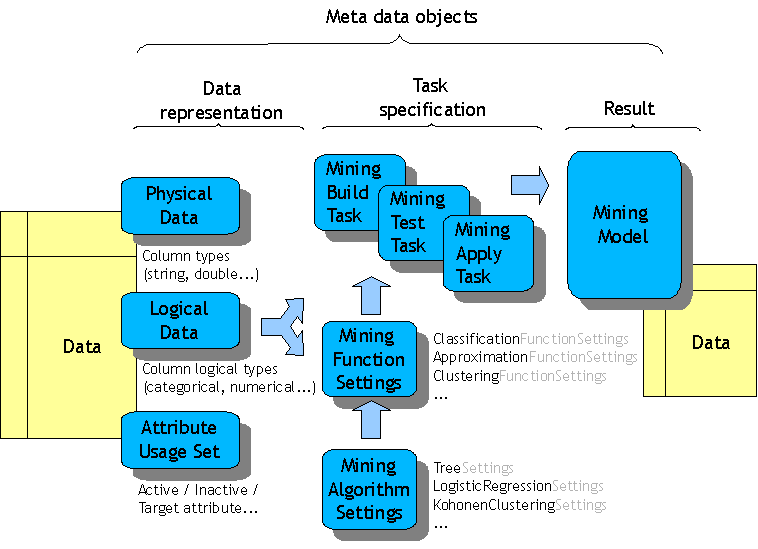
Each object represents a specific part of the process, such as:
Data representation objects
This type of objects includes PhysicalData, LogicalData and AttributeUsageSet. They represent data localisation, physical data structure, data measurement types etc.
Tasks specification objects
Objects control: Tasks
Objects controlling the model construction process (MiningBuildTask), model testing process (e.g. ClassificationTestTask , ApproximationTestTask) and the application of an existing model to new data (MiningApplyTask). These objects are linked with other objects specifying data and algorithms. Once executed they produce objects which represent the results.
Purpose of modelling: Mining Function
An object called MiningFunctionSettings describes the purpose of the modeling e.g. approximation, classification, clustering, which are called Mining Functions.
Algorithm specification: Algorithm Settings
Each Mining Function is linked with a specific algorithm. The algorithm is represented by a separate object. This separation lets the user replace algorithms without altering other objects.
Each Mining Function can be implemented by one or more algorithms, for instance Classification can be implemented by several algorithms like FeedforwardNeuralNetSettings, LogisticRegressionSettings or TreeSettings while Approximation can be implemented by FeedforwardNeuralNetSettings or LinearRegressionSettings For each algorithm there different settings are available. For example, in the case of clustering we can define the number of clusters we would like to identify.
Result objects
The outcome of executing a Mining Build Task is a data mining model represented by separate object. This object also contains a set of statistics associated with the model.
Note
Besides objects mentioned above there are several additional ones (such as Transformation related tasks or Matching task for Data Quality). They are described in the appropriate chapters.
For new or casual users the concepts of the AdvancedMiner system may appear complicated at first. However, a very general approach used in AdvancedMiner allows the analyst to introduce major changes easily and quickly (like changing the classification method or comparing various models). It gives the user a high level of freedom in data processing, data mining and modeling. This approach has been proved to be very useful, especially in complex Data Mining projects.